

 Polski
From a Used Tire to an Electronics Housing, While Germany Basks in Record-Breaking Sun
A week in which the circular economy meets electronics, and solar power in Germany breaks records faster than anyone expected. Here's what's been happening in the sustainability industry, and why both stories are worth following ahead of Poland Sustainability Expo 2026.
01 · Recycling and Innovation
Polish tire-and-plastic composite heading into electronics [1]
We start with proof that hard-to-recycle waste doesn't have to end up in a landfill. A team of researchers from the Military University of Technology and the Warsaw University of Technology has developed a composite made of 90% recovered HDPE polyethylene and 10% rubber sourced from used tires. On its own, such a material wouldn't be anything special, but the researchers went a step further and enhanced it with graphite nanoplatelets.
The result? The composite's thermal conductivity increased fourfold, and its tensile strength improved by 43%. The price of these improvements is a drop in the material's flexibility, so this isn't a universal material for every application. The researchers also stress that the new composite still conducts heat about 130 times worse than aluminum, so replacing metal heat sinks is out of the question. As a lightweight housing, cover, or structural component for electronic devices, though, it's a strong candidate. The study's results were published in the journal "Materials Today Communications," and before commercialization the team still needs to verify the material's durability and the repeatability of its properties when working with successive batches of recycled raw material.
This is a good example of how the circular economy and the electronics industry can drive each other forward — waste that used to be mainly a logistical problem (tires can sit in landfills for years) is gaining a new lease on life in a completely new role.

02 · Solar Energy
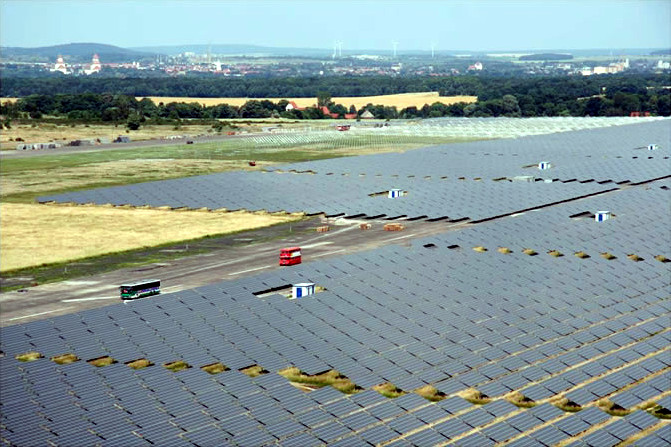
Germany: this year's solar production record was broken already in September [2]
From a Polish laboratory, we move to German rooftops and solar fields, where the numbers speak for themselves. According to data from the German Solar Industry Association (BSW-Solar), based on calculations by the Fraunhofer Institute for Solar Energy Systems ISE, by September 27, 2026, German PV installations had produced a combined 90.2 TWh of energy — more than in all of 2025 (90.0 TWh). In other words, what took Germany twelve months to achieve a year ago has this time been accomplished in under nine.
Two factors are behind the record. First, an exceptionally sunny year — confirmed by data from the German Weather Service. Second, the country's consistent expansion of solar capacity, which means that every extra hour of sunshine now translates into more energy than it did just a year or two ago. The industry decided to mark the moment by informally declaring September 27 "Sun Day."
For Poland, this is a signal of where Europe's energy mix is heading, and how quickly the expansion of PV capacity can shift the energy balance even in an economy as large and industrial as Germany's.
Summary
Summary
From a used tire getting a second life as an electronics housing, to German sunshine breaking annual records three months ahead of schedule — this week shows that sustainability today is, above all, about concrete numbers and real-world implementations, not just declarations. You'll find more stories like these, along with prototypes and conversations with experts, at Poland Sustainability Expo 2026 — see you there!

Invitation
From innovative composites made of waste to solar power records — these are the kinds of topics taking center stage at Poland Sustainability Expo 2026. Meet recycling innovators and renewable energy experts all in one place, see live prototypes, and talk about the implementations that are changing the market. Save the date today!
Poland Sustainability Expo 2026